This success forces one to accept that certain aspects belong to physical reality that go far beyond our intuition and that are therefore very difficult to understand. Among these, none is more intriguing than the concept of quantum entanglement, which mathematically describes how two particles that have at some point in the past interacted with each other retain a memory of this interaction to such an extent that acting on one of the two particles has a measurable influence on the properties of the other particle, even if the two have long ago stopped interacting and may be separated so far away from each other that communication between them is no longer possible.
In a recent paper (L.M. Koll et al, Nature 652, 82 (2026)), resulting from a collaboration between the Max Born Institute (Berlin, Germany) and the Universidad Autónoma de Madrid and IMDEA Nanociencia (Spain), the quantum entanglement between electrons and molecular ions has been investigated at the natural time scale of electronic motion: the attosecond.
In 2022, Alain Aspect, John F. Clauser and Anton Zeilinger received the Nobel Prize "for experiments with entangled photons, establishing the violation of Bell inequalities and pioneering quantum information science". Subsequently, in 2023, Pierre Agostini, Anne L’Huillier and Ferenc Krausz received the Nobel Prize "for experimental methods that generate attosecond pulses of light for the study of electron dynamics in matter". At first sight these two Nobel Prizes have little in common. However, the attosecond pulses currently produced in the laboratory, consisting of extreme-ultraviolet (XUV) radiation with photon energies exceeding the binding energies of any conceivable compound (atom, molecule, liquid or solid), lead to photoionization and the formation of a bi-partite system, i.e. an ion and a photoelectron. These will be entangled whenever the total wave function cannot be written as a single direct product of wave functions describing the ion and the photoelectron.
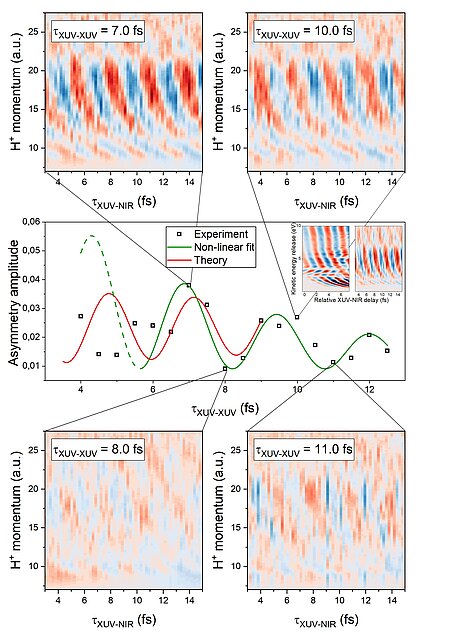
In our experiments, hydrogen molecules (H2) were ionized using a pair of attosecond pulses in combination with a longer infrared pulse, leading to the production of an H2+ ion and a photoelectron, i.e. the two particles that may be entangled. The purpose of the experiment, as in most attosecond experiments, was the observation of ultrafast electron dynamics, in this particular case ultrafast motion of the hole left behind in the H2 molecule after departure of the photoelectron. The observation of such dynamics requires the existence of electronic coherences in the residual H2+ molecular, meaning that the remaining electron in the H2+ ion cannot be assigned to a specific quantum state, but is in a superposition of two quantum states, with a well-defined phase relationship between them. More specifically, the experiment measured on which side of the molecule the hole remained at the end of the experiment, when the H2+ dissociated into the combination of a neutral H-atom (containing the single remaining bound electron) and an H+ ion (containing the hole left behind by the photoelectron). Interestingly, the experiment and the accompanying theoretical calculations showed that the ability to observe the hole dynamics or, equivalently, the coherent electron dynamics in the H2+ ion, depends on the delay between the pair of attosecond pulses that ionize the neutral H2 molecule, which in turn modifies the degree of entanglement between the H2+ ion and the photoelectron.
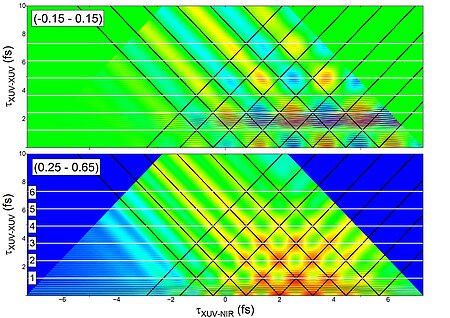
The figure shows the main outcome of the experiment and the theoretical calculations. By varying the delay between the pair of attosecond pulses and an infrared pulse, an oscillation was observed in the position where the hole was preferentially observed at the end of the experiment. The amplitude of this oscillation (i.e. the degree to which preferential hole localization at the end of the experiment could be achieved, that is to say the degree of coherence) depends on the delay between the two attosecond pulses. The figure shows that entanglement in the of H2+ ion + photoelectron systems occurs at the expense of the electronic coherence in the remaining H2+ molecular ion, thus allowing one to control this coherence by just varying the delay between the pulses.
The present work thus opens the way to manipulating coherences and entanglement in more complex molecular system by acting on the attosecond time scale with different combinations of attosecond and few-femtosecond pulses. This could be useful to increase (or decrease) the degree of quantum entanglement in molecular systems whenever this is required, which may be relevant for further development of quantum information technologies.