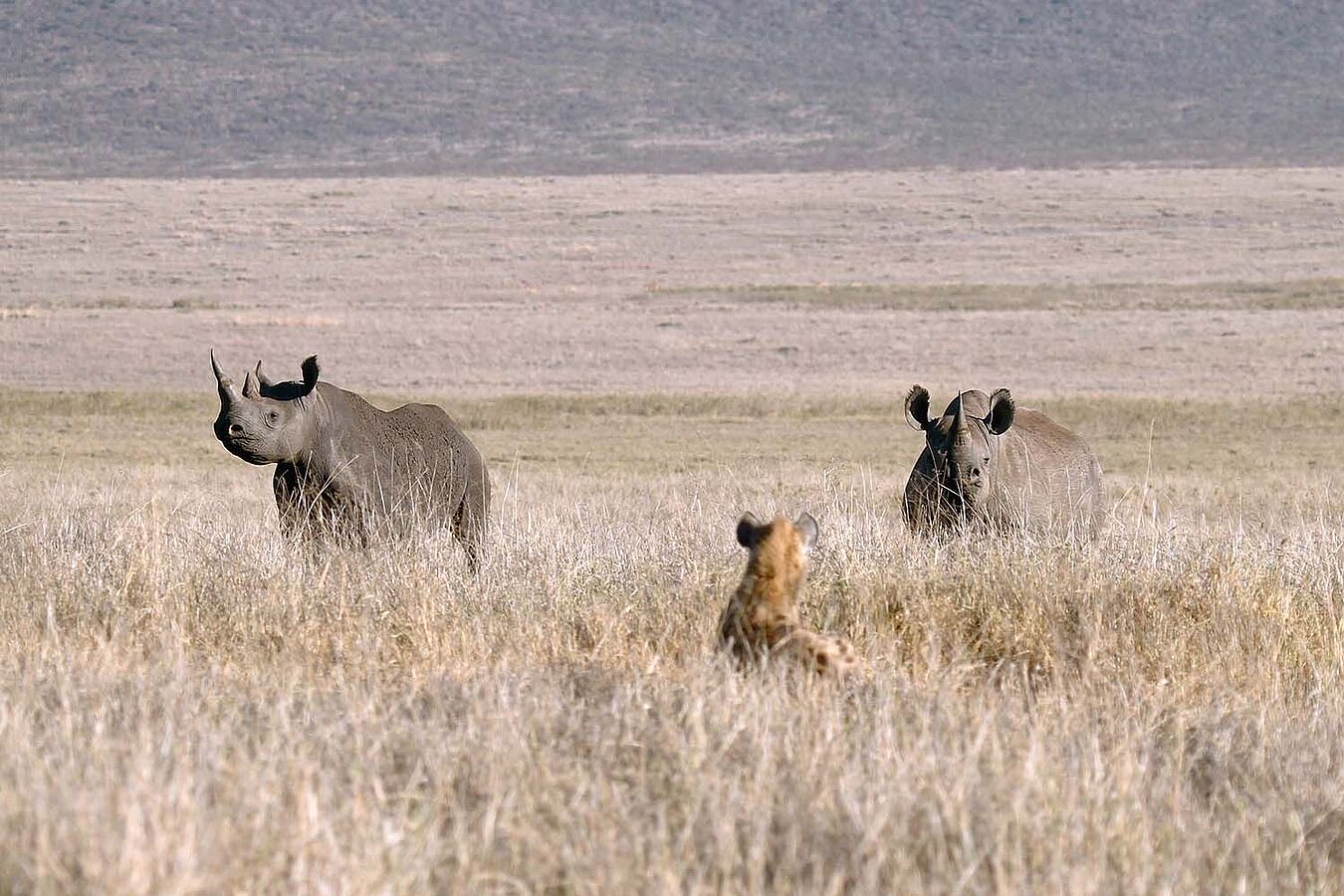
Scientists from the Ngorongoro Hyena Project at the Leibniz Institute for Zoo and Wildlife Research (Leibniz-IZW) analysed this for spotted hyenas in the Ngorongoro Crater in Tanzania using DNA analysis of hundreds of faecal samples collected over 24 years. They found that hyenas rarely eat livestock in the multi-use Ngorongoro Conservation Area, which is also used for grazing, and do not regularly prey on black rhinos. The study is published in the journal “Wildlife Biology”. The project has been running for exactly 30 years and studies the spotted hyenas’ social behaviour, health, ecology and interactions with animals and humans.
In April 1996, behavioural biologists began researching the spotted hyena population in the Ngorongoro Crater in Tanzania in close collaboration with local scientists. The “Ngorongoro Hyena Project” has been running continuously for 30 years now and is based at the Leibniz Institute for Zoo and Wildlife Research in Berlin. During this time, the team has built up one of the world’s most significant long-term datasets on a wild mammal population. They have known all the spotted hyenas of the eight clans in the crater since 1996 and possess detailed data on the life histories of more than 3,300 individuals, as well as a comprehensive genetic pedigree spanning 10 generations. Drawing on this immense dataset, they investigate behaviour, sexual conflicts, the role of social status and mate choice, diseases and their consequences, interactions with food competitors and predators, and, last but not least, coexistence with humans.
Only four percent of detected prey is livestock and none is rhino
Between 1996 and 2019, the scientists collected over 500 faecal samples from spotted hyenas in the study area. The samples were analysed using the metabarcoding method – a DNA analysis technique for simultaneously identifying many species from complex mixed or environmental samples – in order to determine the hyenas’ diet. 371 samples yielded usable results. In these, the team was able to detect DNA from a prey species a total of 434 times – from 20 different animal species. “In this study, we were particularly interested in livestock and black rhinos,” says project leader Dr Oliver Höner. “The crater is densely populated with wild ungulates. At the same time, the number of cattle, donkeys and sheep in the surrounding area has risen dramatically over the 24 years of the study, to over 200,000 of each. The hyenas venture into these areas outside the crater – which are also part of the Ngorongoro Conservation Area – when there is little prey to be found in their own territory. Consequently, there has been speculation that livestock make up a significant proportion of the hyenas’ diet. Our interest in the rhinos is motivated by a conservation perspective; black rhinos in particular are very rare and are classified as ‘critically endangered’ by the IUCN.”
By far the most common prey of the Ngorongoro spotted hyenas is wildebeest, which was detected 229 times with the Metabarcoding method. This is followed by zebras with 75 records and buffalo with 57. The most common domestic animal detected in the hyenas’ faeces is the donkey, with 7 records. Cattle (6) and goat (2) were even rarer. In total, only 18 records were attributed to livestock, accounting for 4.1 percent of all records. No rhino DNA was found in any of the samples. The scientists concluded that spotted hyenas have minimal to no impact on the populations of black rhinos – a species in particular need of protection – within the Ngorongoro ecosystem, which is rich in other prey, and that they very rarely eat livestock. “Concerning human-wildlife conflicts as well as conservation issues, discussions and decisions are often made without sufficient evidence regarding the impact of predators”, says Höner. “We hope that our findings will contribute to more objective and better management decisions.”
Older hyenas feed on livestock more frequently than younger hyenas
Thanks to the large spotted hyena dataset, the scientists from the Ngorongoro Hyena Project were also able to investigate whether age, social status or sex influence dietary composition. The result is clear: hyenas in whose faeces DNA from livestock was found were, on average, almost three years older than conspecifics who had fed exclusively on wildlife at that time (9.1 versus 6.2 years). There was no difference between the two dietary groups in terms of social rank or sex. “For every year a hyena gets older, the probability that it will eat a domestic animal increases by almost 27 per cent,” explains Dr Eve Davidian, a scientist at the Institut des Sciences de l’Evolution de Montpellier in France and co-director of the Ngorongoro Hyena Project. “One possible explanation for this is that older hyenas are no longer able to hunt fast and agile wild animals as successfully as younger hyenas. Farm animals are therefore an easier alternative to hunt. It is worth noting that, despite the ease of access to and the simpler nature of hunting farm animals, the overwhelming majority of the hyenas’ diet in the Ngorongoro Crater consists of wild ungulates.”
30 years of spotted hyena research in Tanzania
The team has been studying spotted hyenas in the Ngorongoro Crater, a UNESCO World Heritage Site, for 30 years now. Since then, dozens of team members have spent time with generations of hyenas, sharing their daily lives with the animals – and they are still learning something new about them every day. The animals’ intelligence, social behaviour, curiosity, playfulness and spirit of discovery continue to fascinate them and have inspired not only widely published basic research, but also applied wildlife research that can lead to better protection for the hyenas and their contribution to a healthy ecosystem