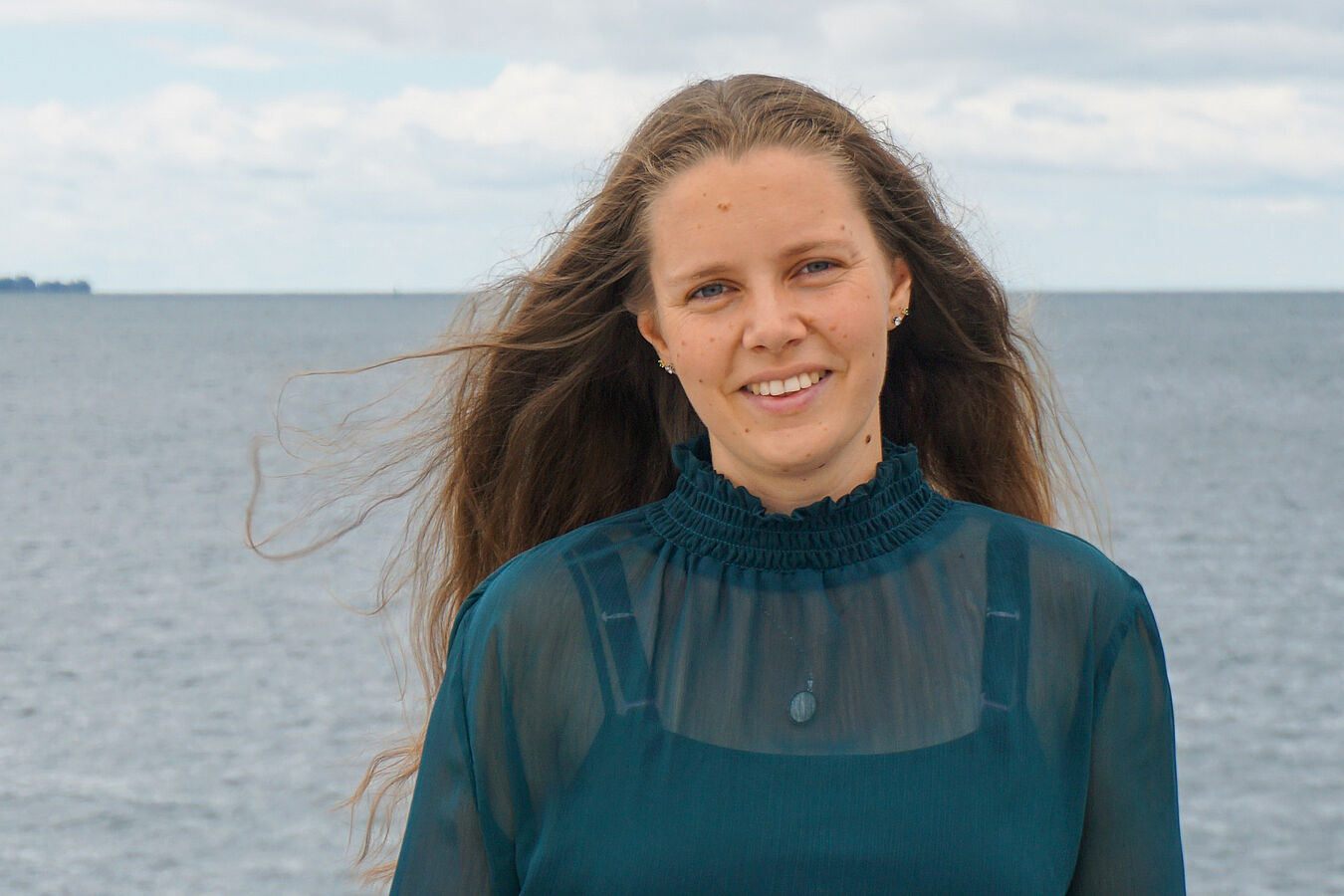
This year, the Forschungsverbund Berlin e. V. (FVB) honors physicist Dr. Lara Greten with the Marthe Vogt Award. In her doctoral thesis entitled “Nanoscale Light-Matter Interaction of Ultrathin Materials,” Dr. Greten developed a unified microscopic theory capable of describing and predicting how light interacts with ultrathin materials in complex hybrid systems. As such, her doctoral thesis provides a better theoretical understanding of novel optical properties at the nanoscale and lays the groundwork for future applications in nano and quantum optics.
The award winner
Dr. Lara Greten was born in Berlin in 1997. She studied physics at Technische Universität Berlin, earning her master’s degree with a grade of 1.0 in 2021. In October 2025, she completed her doctoral degree in the field of theoretical solid-state physics and quantum optics at the same university, graduating summa cum laude. In her thesis Dr. Greten examines how light interacts with matter at the nanoscale. Her research focuses on ultrathin materials and hybrid systems that combine two-dimensional materials – which are just a few atoms thick – with nanometer-scale metal structures. The interaction of these different structures can give rise to new optical properties. Understanding these properties in detail and harnessing them for future technological applications requires a microscopic understanding of the underlying interactions. To this end, Dr. Greten developed a theoretical approach that uniformly describes various material systems and forms of light-matter interaction.
Dr. Greten is delighted to receive the Marthe Vogt Award. She sees the award as recognition of her work thus far and as an opportunity to advance her career. “Unfortunately, there is no planning security in academia, so an award like this increases my chances of pursuing a long-term career there,” she said. Dr. Greten added that the award serves as visible recognition of her work outside the academic world.
Lara Greten has been conducting research on quantum optics and light-matter interactions as a postdoctoral fellow at Queen’s University in Kingston, Canada since March 2026. This work is made possible through a Feodor Lynen Fellowship from the Alexander von Humboldt Foundation. Dr. Greten has already received numerous awards for her scientific achievements. These include the 2022 Physics Study Award from the Physical Society of Berlin, the 2021 Clara von Simson Prize from TU Berlin, and a fellowship to participate in the 73rd Lindau Nobel Laureate Meeting. Lara Greten received awards for her academic excellence even in high school, where she was honored with the Young Physicists’ Award from the Physical Society of Berlin and the “Abiturpreis der DMV” from the German Mathematical Society. “Even as a child, I was always asking ‘why’ questions,” said Greten. “That’s what fascinates me so much about physics. It’s about answering ‘why’ questions in the language of mathematics.” She doesn’t find it frustrating that every answer leads to at least two new questions. In fact, she finds it exciting: “It never gets boring!”
In addition to her research, Dr. Greten is also involved in teaching. At TU Berlin, she taught courses in quantum mechanics, optics, and solid-state theory at the bachelor’s and master’s levels, among other subjects. “I never truly understand a topic until I can explain it in a way that others can understand,” she remarked.
She has one simple piece of advice for young female physicists: “Stay true to yourself.”
This year’s Marthe Vogt Award expert panel was particularly impressed by the creativity of Dr. Greten’s theoretical approaches and the practical impact of her theory – which can describe other types of two-dimensional systems – within the scientific community. For instance, the description she developed is currently employed to understand the optical properties of low-dimensional and hybrid material systems involving a combination of experiment and theory. Furthermore, her theory provided the microscopic understanding that enabled her to predict novel optical approaches for investigating the quantum structure of matter, in which “nanometer-scale materials” are analyzed using “nanometer-scale light.”
Professor Dr. Stefan Eisebitt, a jury member and director at the Max Born Institute for Nonlinear Optics and Short Pulse Spectroscopy, explained: “For several years now, it has been possible to fabricate complex hybrid systems from so-called two-dimensional materials – which are only a few atoms thick – and nanometer-scale metal objects. This is particularly interesting because the contact between the different structures in the hybrid systems gives rise to entirely new optical properties that could be exploited in future applications.”
The award
The Marthe Vogt Award (formerly known as the Award for Young Women Scientists) was established in 2001 by the Forschungsverbund Berlin. It is named after Marthe Louise Vogt (1903–2003), a pharmacologist and neurologist who researched neurotransmitters. Vogt worked as a senior scientist at the Kaiser Wilhelm Institute for Brain Research in Berlin-Buch. In 1935, she left Germany due to her opposition to National Socialism and migrated to Great Britain, where she continued her research with great success.
The prize, worth €3,000, is awarded to young women scientists from the Berlin-Brandenburg region who recently submitted outstanding doctoral theses in the research areas of the FVB institutes. These areas include molecular pharmacology, structural biology and chemical biology, new materials, aquatic ecology and biodiversity research, biology, veterinary medicine and environmental research, nanomaterials, quantum materials, optoelectronics and materials science, laser research and light-matter interaction, and applied mathematics. Directors of non-university scientific institutions, as well as professors and habilitated members of university faculties, are eligible to submit nominations.
The first award winner, in 2001, was biochemist Dr. Kathrin Plath, who now heads her own lab at UCLA.
The award ceremony
The award presentation ceremony will take place at 18:00 on October 1, 2026, at the Museum für Naturkunde Berlin. Many high-ranking guests have been invited to the event. As part of the festive ceremony, Dr. Lara Greten will present her thesis Professor Dorothea Fiedler, FVB Executive Board Spokesperson, chair of the jury, and Director at the Forschungsinstitut für Molekulare Pharmakologie, will deliver the welcome address. In addition, Dr. Anneke Steegh, a gender and identity studies researcher at the Leibniz Institute for Science and Mathematics Education in Kiel, will deliver an engaging keynote address titled “Science needs attitude – On courage, people, and just giving it a try.”