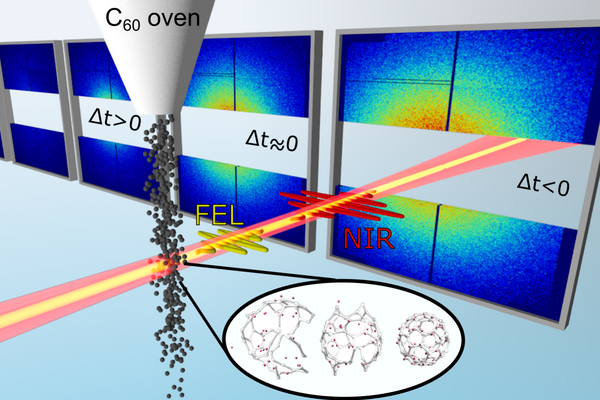
For the first time, the experiment carried out at the Linac Coherent Light Source (LCLS) of the SLAC National Accelerator Laboratory could image strong-laser-driven molecular dynamics in C60 directly.
When C60 molecules are irradiated with intense laser light, they undergo disintegration into neutral and ionic fragments. The amount and the size/charge state of these fragments depend on the intensity of the laser light. This process is typically studied by time-resolved mass spectroscopy, where charged fragments are detected and secondary processes of the highly excited fragments during the detection cannot be excluded. Thus, the initial reaction of the C60 molecules after irradiation with intense laser light, such as possible shape changes, remains hidden.
In the present publication a different approach was followed by making use of ultra short X-ray pulses available at the LCLS facility: The shape of the C60 molecules was determined taking images of the scattered X-ray photons. This technique basically images the electron distribution within the C60 molecule. Fig. 1 shows a sketch of the experimental setup. An ensemble of C60 molecules was excited and ionized by a near infrared (NIR) pulse. The X-ray pulse interacted with the excited C60 molecules and the scattered photons were imaged by a 2-dimensional detector. To follow the changes of the C60 shape, the delay time Δt between the NIR and the X-ray pulse was varied. By changing the intensity of the NIR pulses different fragmentation scenarios could be studied and compared to theoretical calculations. (see insert in Fig. 1)
The experimental and theoretical results show that the evolution of the molecular shape changes strongly when the intensity of the NIR laser pulse is varied. The most remarkable result is the absence of the theoretically predicted laser induced C60 breathing vibration, i.e. a periodic change of the C60 diameter, in the experiment. This may hint at a still incomplete understanding of the C60 dynamics as a multiparticle system.