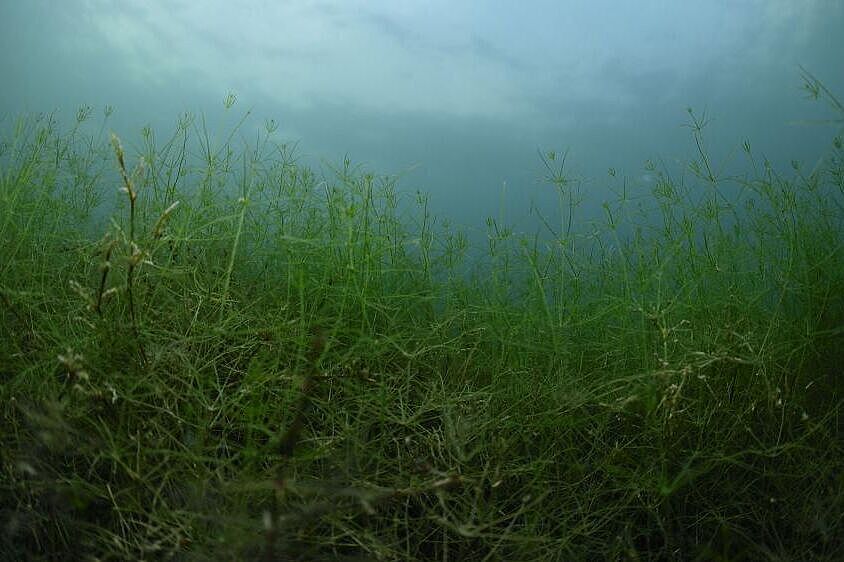
Charophytes are extremely beneficial to lakes, improving water quality and biodiversity. However, their abundance was found to decline in many lakes without clear signs of eutrophication during recent decades. Today, a team from the Leibniz Institute of Freshwater Ecology and Inland Fisheries (IGB) in Berlin and the Feldberg-Uckermärkische Seenlandschaft e. V. (FFUS) association published recommendations for practitioners on the reintroduction of charophytes. Research conducted at 27 test lakes in north-eastern Germany revealed that the abundance of charophytes increased again in almost 80 per cent of the lakes thanks to the measures taken.
Charophytes are underwater plants that play a crucial role in the water quality and biodiversity of lakes; they stabilize the lake bed, produce oxygen, promote water clarity, and provide habitat for numerous aquatic organisms. In Europe, their abundance has declined sharply since the late 19th century.
The scientific basis for the recommendation for action: research on 27 test lakes
Rüdiger Mauersberger, the project leader from FFUS, explained: “Over the last 15 to 20 years, we have observed drastic declines in the previously largely intact charophyte meadows in many lakes in north-eastern Germany. To systematically investigate the complex causes, we developed this “testing and development project (E+E Project)” in collaboration with the Federal Agency for Nature Conservation (BfN). This enabled us to test various charophyte reintroduction measures in 27 calcareous, nutrient-poor, hard-water lakes in north-eastern Germany over a period of four years.”
The measures examined included changes in water chemistry in terms of nutrient, calcium, and inorganic carbon content, adjustments to fish communities, and protection of charophytes from predation. The effectiveness of these measures was scientifically analysed by IGB.
Success of the measures: charophytes are growing again in 80 percent of the test lakes
Dr. Sabine Hilt from IGB reported: "We compared the development of water chemistry, fish stocks, and charophystes in the test lakes with those in comparison lakes where no measures were taken. In 77 percent of the test lakes, charophyte abundance improved, while no such changes were observed in the nine reference lakes during the project period. Based on these results and existing literature, we developed the recommendations for action presented today for selecting suitable measures for the reintroduction of characeae in hardwater, oligo- to mesotrophic – nutrient-poor – lakes in Germany."
Sabine Riewenherm, President of the BfN, emphasized: "This recommendation for action is the first time that a scheme has been presented that users can employ to derive measures for the reintroduction of charophytes in a targeted manner for individual lakes. With the help of the results and experience gained from the E+E project, the impact of different measures on the development of charophytes could be compared. This is a building block for the conservation of our biological diversity."