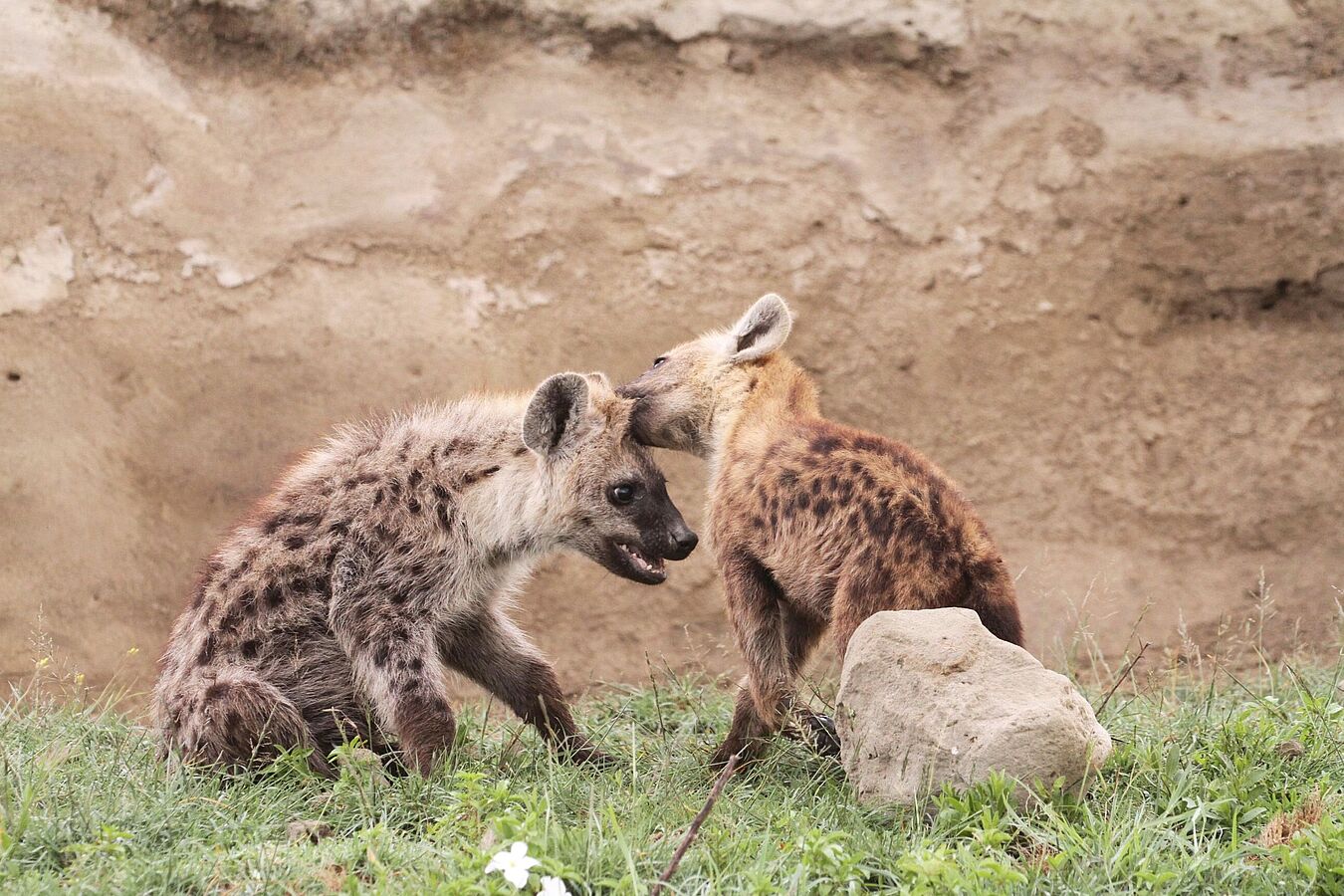
A new scientific study dispels preconceptions about these iconic predators and shows that spotted hyenas exhibit highly developed social behaviour and sophisticated communication involving facial expressions and vocalisations. The study is the result of a collaboration between the Department of Ethology at the University of Pisa, the Ngorongoro Hyena Project at the Leibniz Institute for Zoo and Wildlife Research, and Siyafunda Wildlife & Conservation.
The scientists observed spotted hyenas (Crocuta crocuta) playing in the wild and found that their precise and sophisticated communication is on par with that of many primate species. Hyenas play and romp with one another at all stages of life. Although juveniles play more frequently than adults, the joy of play can also be observed in adults. Interestingly, adult hyenas appear to particularly enjoy playing in water.
Complex communication underpins playful fighting
Play fighting is a form of social interaction that requires fine-tuned communication between the participants to prevent misunderstandings and minimise the risk of escalation. This is particularly important in the case of large and powerful predators such as hyenas. To ensure that their playmate understands their peaceful intentions, the animals use various body language signals. In mammals, the ‘Relaxed Open Mouth’ (ROM) is the most common visual play signal, typically displayed within the other animal’s field of vision to convey peaceful intentions. In contrast, vocal signals have so far been understudied, partly because the animals producing the sounds cannot be reliably identified.
Hyenas are adept at facial expressions and nuanced vocalisations
The new study shows that hyenas in the wild combine visual and vocal body language signals to maintain a shared understanding of playful intent, even within a group. The scientists observed in Tanzania and South Africa that whilst hyenas frequently use the play signal ‘Relaxed Open Mouth’ (ROM) during one-to-one play – that is, when there is direct eye contact – they increasingly combine this play signal with vocalisations in more complex group situations. Oliver Höner, co-author of the study and senior scientist at the Leibniz-IZW explains: “When several hyenas are playing together and they cannot be sure that all participants can see the ROM, they employ additional signals in the form of play-specific vocalisations that are registered and understood at all times by all participants.” The hyenas observed by the research team used a total of 13 different vocalisations whilst playing, five of which had never been described before. The scientists suspect that these nuanced vocalisations are intended to compensate for the lack of eye contact during group play.
This adaptive use of multiple forms of communication highlights the ability of spotted hyenas to actively adapt their body language to the respective social context – an indication of their advanced cognitive and social abilities.
The Leibniz-IZW’s Ngorongoro Hyena Project has been studying hyena populations in the Ngorongoro Crater in Tanzania for more than 30 years.