Despite decades of research, however, what happens immediately after such a bond absorbs light has remained surprisingly difficult to observe due to how fast the initial dynamics take place. In a recent study, researchers at the Max Born Institute, the National Research Council in Canada, and the University of Ottawa used ultrashort vacuum-ultraviolet laser pulses lasting less than four femtoseconds, combined with time-resolved photoelectron spectroscopy to resolve the molecular response following the photoexcitation of ethylene.
In simplified terms, one laser pulse was used to start the molecular dynamics, while a second pulse was used to take a series of ultrafast “snapshots” of the molecule as it evolved, essentially by monitoring how the photoelectron kinetic energy following photoionization changed over time. In this way, the measurements made it possible to follow the coupled electronic and structural evolution of ethylene with unprecedented time resolution. However, the experiment alone revealed only part of the underlying dynamics. The measurements were therefore combined with advanced quantum-dynamics calculations to connect the experimentally observed features to changes in the electronic structure and nuclear motion of the molecule.
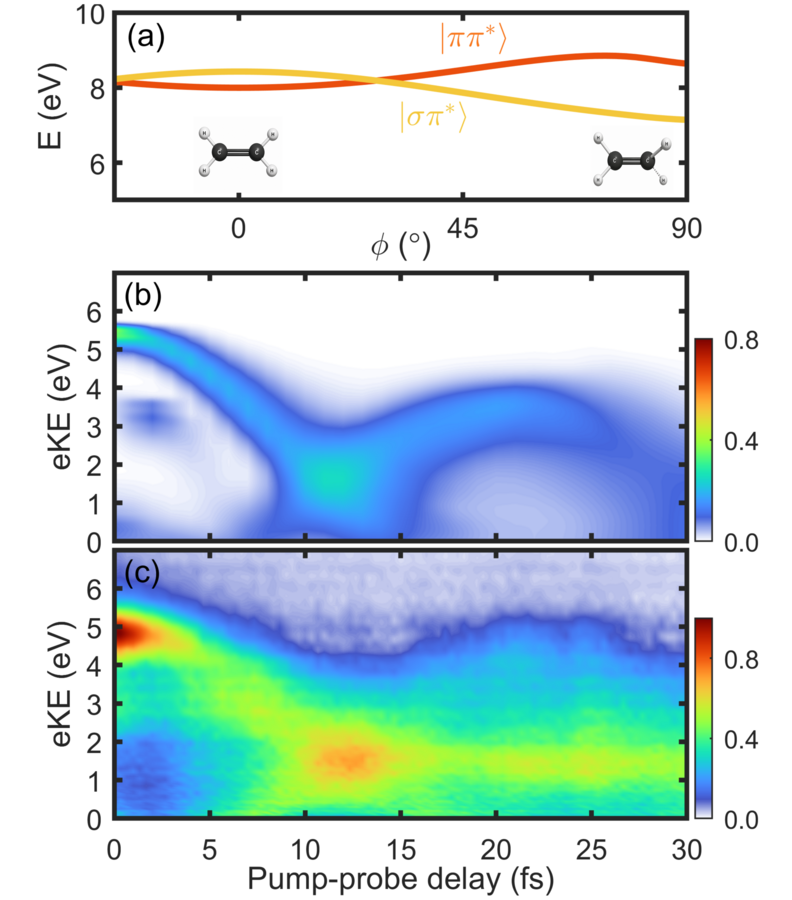
After absorbing one 160 nm photon, ethylene is initially excited into what is known as a ππ* electronic state. Traditionally, the subsequent twisting of the carbon–carbon double bond has largely been understood in terms of motion on this excited-state energy potential. The combined experimental and theoretical results reveal an important additional ingredient: the initially excited ππ* state is strongly coupled to another electronic state, known as σπ*. The calculations show that population is transferred rapidly into this state, and that this change in electronic character is intimately connected to the twisting motion of the molecule. In other words, the carbon–carbon double bond does not simply begin twisting on the electronic state in which it was initially excited. Instead, the motion emerges from a rapid interplay between different electronic states. The experiment provides direct fingerprints of this process. Remarkably, the simulations reproduce the major features observed in the few-femtosecond photoelectron measurements, allowing the changing electronic character of the molecule to be directly connected to its structural motion (see Fig. 1).
This new result therefore provide a revised framework for thinking about the earliest stages of photochemistry in molecules containing carbon–carbon double bonds. More broadly, understanding how electronic states interact to direct molecular motion could eventually help us learn how to control photochemical reactions—for example through molecular design or chemical substitution. Sometimes, understanding complex chemistry starts with looking very closely—and very quickly—at the simplest molecule possible.