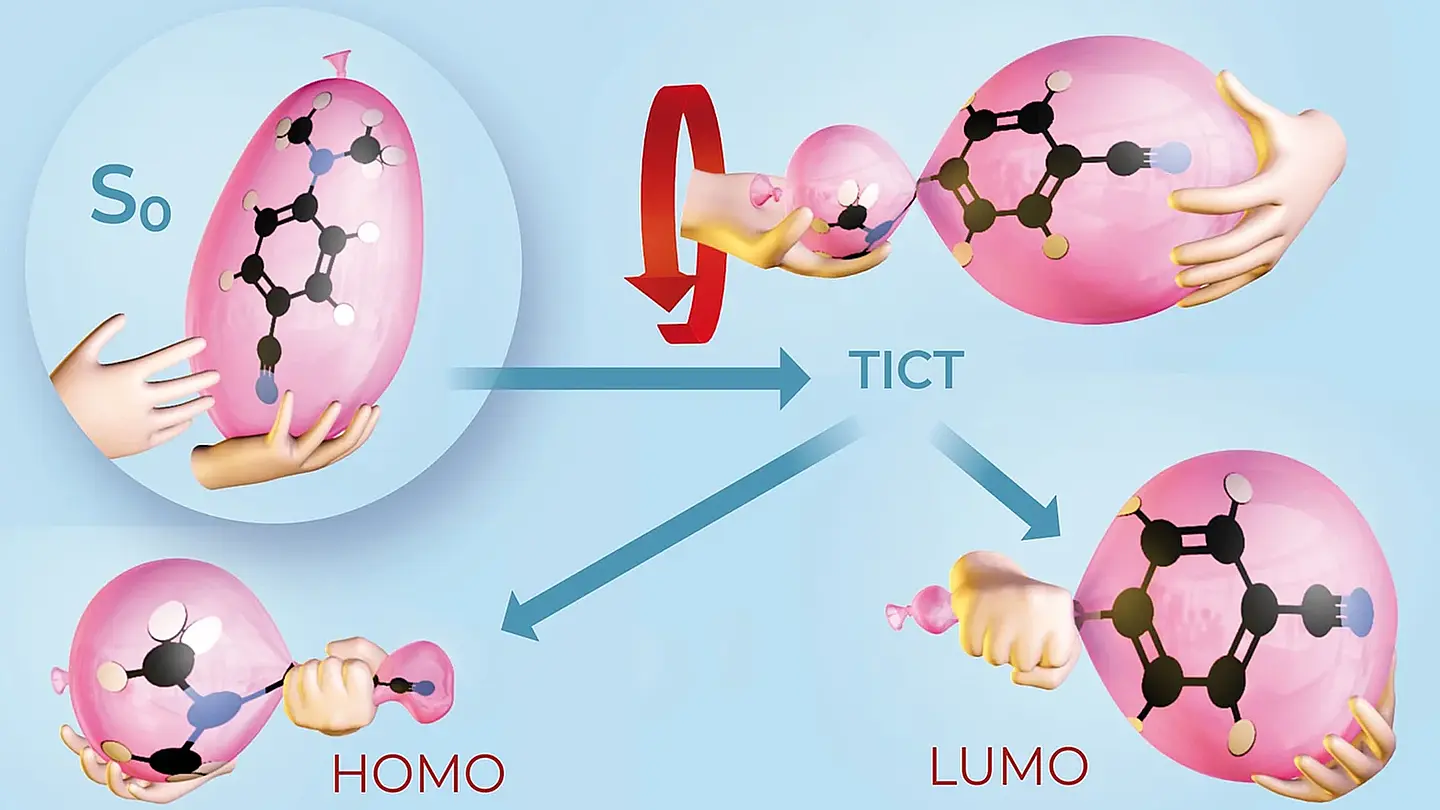
The wide variety of donor and acceptor groups enable targeted design of push-pull chromophores that are crucial in molecular design and applications such as solar energy conversion, organic electronics and optoelectronics. Scientists of the Max Born Institute of Nonlinear Optics and Short Pulse Spectroscopy have, in a collaboration with University of Ottawa (Canada), Uppsala University (Sweden) and Helmholtz Zentrum Berlin-BESSYII, now have shed light on the underlying key process of light-triggered intramolecular charge transfer of the prototype 4-dimethylaminobenzonitrile DMABN. The results have been published in Chemical Science, 2026, 17 (44), 21344-21351 (DOI: 10.1039/d6sc06430b).
The results put a definitive mark to the decades-old debate of the cause of dual emission by this model push-pull chromophore DMABN, a molecule that has puzzled chemists for over 50 years. In the combined experimental and theoretical study it is shown how crucial information can be obtained with soft-X-ray spectroscopy on the electronic structure and how this changes upon absorption of light. For DMABN conclusive evidence is delivered on molecular twisting upon charge transfer as the driving mechanism in this archetypal donor-bridge-acceptor system.
Using pioneering transient X-ray absorption spectroscopy, it is possible able to directly access the core question of photochemistry of the DMABN molecule, by resolving the local electronic structures of the donor and acceptor moieties separately. Supported by state-of-the-art CVS-DFT/MRCI calculations, not only the twisting mechanism is validated but also a quantification of the orbital and charge distributions in the DMABN excited states. This is illustrated using a balloon diagram, with which conveniently a visualization can be made of the relocation of electronic charge distributions in DMABN—i.e., what the locally excited (LE) and twisted intramolecular charge transfer (TICT) states actually represent.
These scientific results redefine how the impact of charge transfer and charge flow can be understood, and provide a new methodology that will be transformative for the field of photochemistry, and can be extended towards molecular systems ranging from photochromic switches, molecular machines, organic light-emitting diodes, organic photovoltaic cells and light-harvesting systems.
This article is licensed under a Creative Commons Attribution-Non Commercial 4.0 Unported Licence. You can use material from this article in other publications without requesting further permissions from the RSC, provided that the correct acknowledgement is given and it is not used for commercial purposes.
The Inside Cover Figure, and earlier versions showing the same concept, have been developed by Mate Kurucz (Idea), Erik T.J. Nibbering (Idea) and Martin Künsting/Illustration (Graphics).