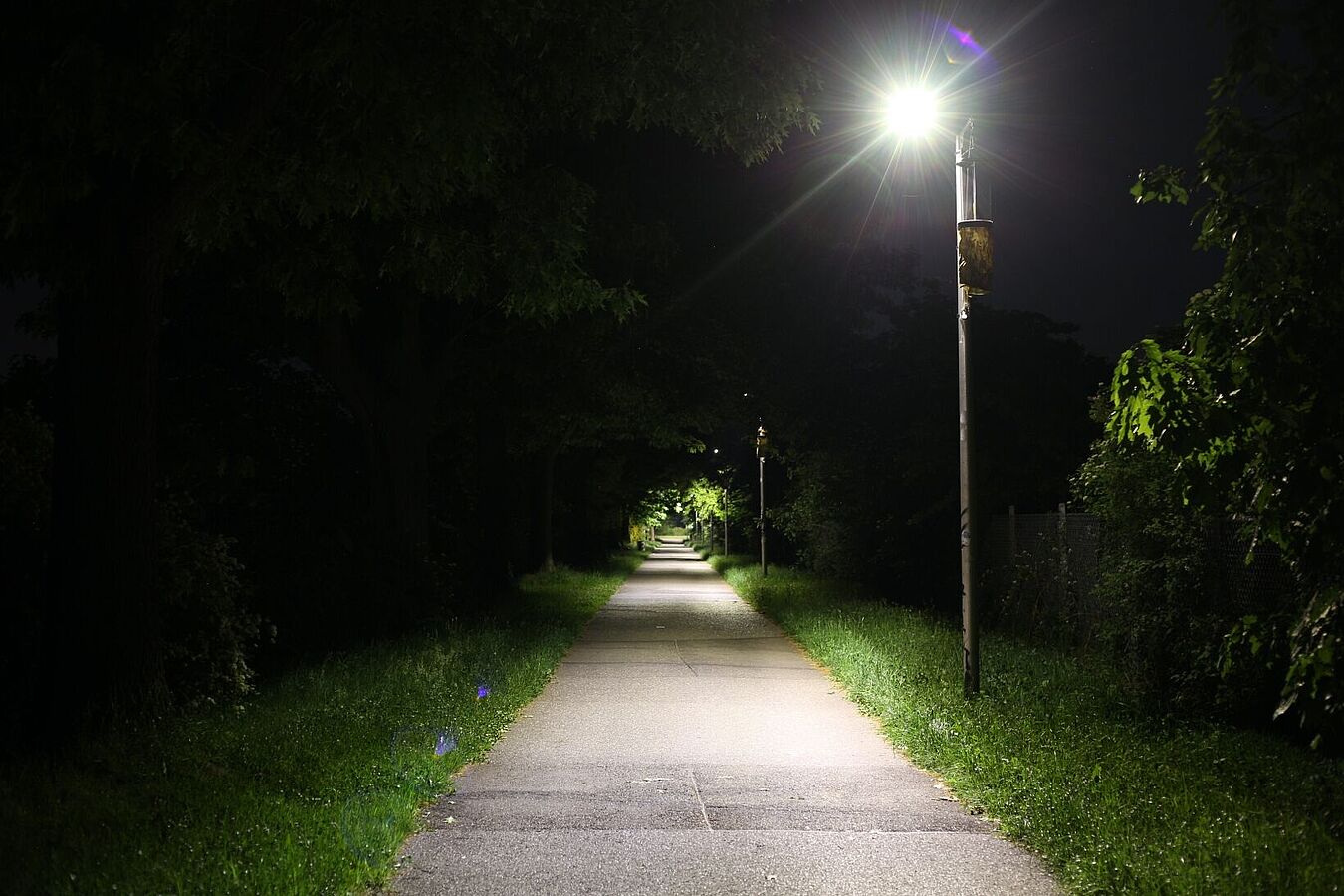
The lighting system was developed in collaboration with the Leibniz Institute of Freshwater Ecology and Inland Fisheries (IGB) and the Technical University of Berlin and was awarded the German Sustainability Prize in the “Transformation Products Nature” category. According to the jury, it is an important technical solution to reduce insect decline.
Tal Shield reduces spill light precisely where insects are active, making the lamp significantly less attractive to them. Field studies by IGB have shown that the attraction to insects can be reduced by up to 92 percent compared to conventional LED lighting without compromising traffic safety.
The luminaire uses specially designed shields that direct the light precisely onto roads and paths. In combination with “circular light profiles,” which adapt the light color and intensity to the activity patterns of nocturnal insects, Tal Shield helps to harmonize the needs of humans and nature. Pilot projects in German municipalities such as Ahrenshoop, Fürth, and Karlsruhe prove that light pollution and stress on wildlife can be reduced while saving energy at the same time.
The jury acknowledged the scientifically sound approach, which combines ecological considerations with technical efficiency. The scalable concept offers municipalities a practical solution for biodiversity conservation and sustainable urban development.
Dr. Sibylle Schroer, coordinator of the light pollution research projects at the IGB, is enthusiastic: “It all started with an idea: What if lights had masks that directed the light precisely where we need it at night — on the sidewalk or the street, but no longer in the flight path of insects? This award recognizes the interplay between intensive networking and scientific expertise, because translating scientific findings into municipal contexts requires a high level of communication and administrative effort.”
Dr. Franz Hölker, head of the research group "Light Pollution and Ecophysiology", emphasized the significance of the award: “We in the Light Pollution Research Team are delighted to receive this award and hope that the product will find widespread application — especially in sensitive areas such as nature reserves, freshwater ecosystems, and other areas with high biodiversity.”
The award should motivate lighting manufacturers to further advance light shielding. Optics could greatly improve the efficiency of the prototype. This investment is immensely important for the future of insect fauna.
LiTG Young Talent Award for Catherine Pérez Vega
And there is another award for the research group: former doctoral student Dr. rer. nat. Catherine Pérez Vega received the LiTG Young Talent Award for Light, Technology, and Design 2025 (Category II: Dissertations) from the German Society for Lighting Technology and Lighting Design (Deutsche Gesellschaft für LichtTechnik und LichtGestaltung e.V.) for her dissertation.
The title of the dissertation is “The Environmental Impact of Artificial Light in Urban Settings: Gaps, Challenges, and Sustainable Lighting Design". Using the example of the Spree River in Berlin, Catherine Pérez Vega investigated the extent to which light pollution affects water bodies. Adopting a transdisciplinary approach, she developed design guidelines for lighting systems near waterways to protect migratory fish from light pollution. Migratory fish, such as salmon and eel, are particulary sensitive to lighting from bridges and roads because it can alter their natural movement patterns, thereby endangering their reproduction and survival.