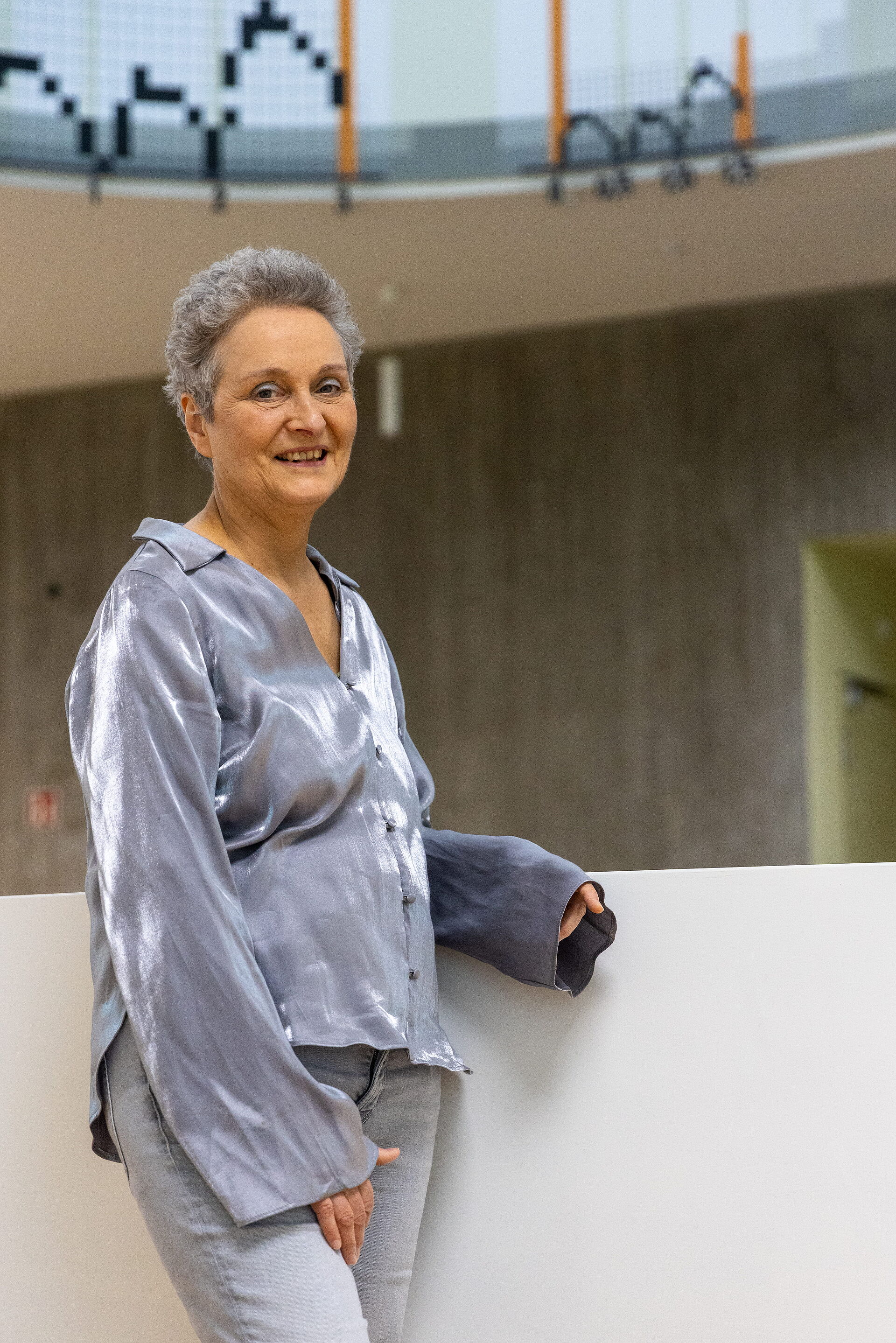
Patricia Löwe: As a young artist, you were a sculptor, focusing on creating sculptures. Today, you work with a variety of media. Through your work, you explore time, space, data, processes, sequences, and movements, translating them into your pictorial world. How did you evolve from being a sculptor to becoming an artist who creates such multilayered installations?
Ursula Damm: I studied at the Kunstakademie Düsseldorf. It was Joseph Beuys’s work that inspired me to pursue sculpture. But even then, it wasn’t in the classical sense – his concepts of sculpture and public space were much more open.[1] What drove me was the desire to enable participation rather than to create static sculptures. What we create as artists should act as mediators between the viewer and the artist. To achieve this, an artist must engage intensely with the subject matter of their work and with the audience. Also, like many artists, I have an empathetic vision: I feel something and want to convey those exact feelings. For the last four decades, I have considered this my greatest task.
PL: You mentioned engaging with viewers in the spirit of an empathetic mediation process. How do you approach this task?
UD: I am interested in interactivity, especially real-time interaction[2]. This presents an enormous challenge. In the early days of interactive installation in Europe in the 1990s, real-time interaction was not always the focus. Many people shied away from transforming a signal from the present into something vivid that makes this process tangible. Instead, they used data that had been collected or purchased elsewhere. However, I wanted to produce location- and time-related images that reveal more; images that are immediate and situational.
PL: I’m guessing that to do that, you had to gain a lot of technical expertise.
UD: I learned how to program. This inevitably led me to “art and science.” I had to learn how to collaborate with scientists and delve deeply into unfamiliar subject matter. I was already 35 years old when I started. That was a good thing! I already had my feet firmly planted in the world of art.
Obviously, “A Biological Clock” is not interactive. This is primarily due to budget constraints. We would have needed a device that was far too expensive for the final setup alone.
PL: Your artwork explores ecosystems, small organisms, and environmental and climate issues. How did you discover your theme?
UD: Of course, there is a moral dimension to this. I studied under Günther Uecker, not Beuys. Uecker always said, “If the Earth is destroyed, then we’ll just fly to the moon or Mars.” Unfortunately, this idea is still relevant today – or has become relevant again. That statement infuriated me. I thought, “That’s no solution!” I wanted to protect this Earth even back then.
Later, I discovered Uexküll[3]. He believed that, in order to understand how living beings function, one must enter their worlds. His great achievement was to describe how every living creature lives in its own self-contained bubble. No one can look into the consciousness of another being from the outside. Only those inside know what it looks like. This insight, this respect for the other, was enormously important to me. Uexküll extensively explored how one can still learn something about other living beings despite their closed bubbles.
This is where my political impetus lies: It’s important to enter another’s environment and understand what can be learned from their world in a given situation. Once this is possible, a foundation is established for meaningful, morally valuable exchange with other (living) beings.
PL: So you were already interested in the subject as a student.
UD: I grew up and became rooted in the early environmental movement. Beuys was also a Green. Initially, I wanted nothing to do with computers, in keeping with this mindset. I only succumbed to technology through mathematics.
PL: As an artist, you have extensive experience working with scientific content. How do you typically approach a project like this?
UD: Yes, I’ve been working on this for a long time. However, for organizational reasons, it’s not that easy. As an artist, when I propose a theme, I need a budget to pay the scientists so they can focus on exploring my questions using their methods instead of juggling this alongside their demanding work. This is almost impossible in Germany. There are no joint funding sources for art and science. Neither the German Research Foundation nor the Federal Ministry of Research, Technology and Space funds art. Scientists have little incentive to team up with artists to write grant applications because such proposals tend to be unsuccessful. I’ve often failed in this regard – in recent years, in fact, almost always. Currently, the EU is really the only entity that can fund such projects. However, it’s very difficult to incorporate artistic content into Horizon 2020 projects, for example.
PL: You obviously approach art and science projects from an artist’s perspective. Have you ever encountered situations involving friction with scientists?
UD: The main problem with “art and science” is that artists are not usually included in scientific contexts to a sufficient degree to foster empathy. In order to take a position, I must delve deeply into abstract content. In this context, I don’t believe in artistic geniuses. Understanding something takes a lot of work and time. There also need to be foundations in place. If a research subject becomes too abstract and I haven’t had the opportunity to gain experience with it myself, then I can only draw on the experiences of scientists who have. In that case, of course, I can’t reveal or convey anything original.
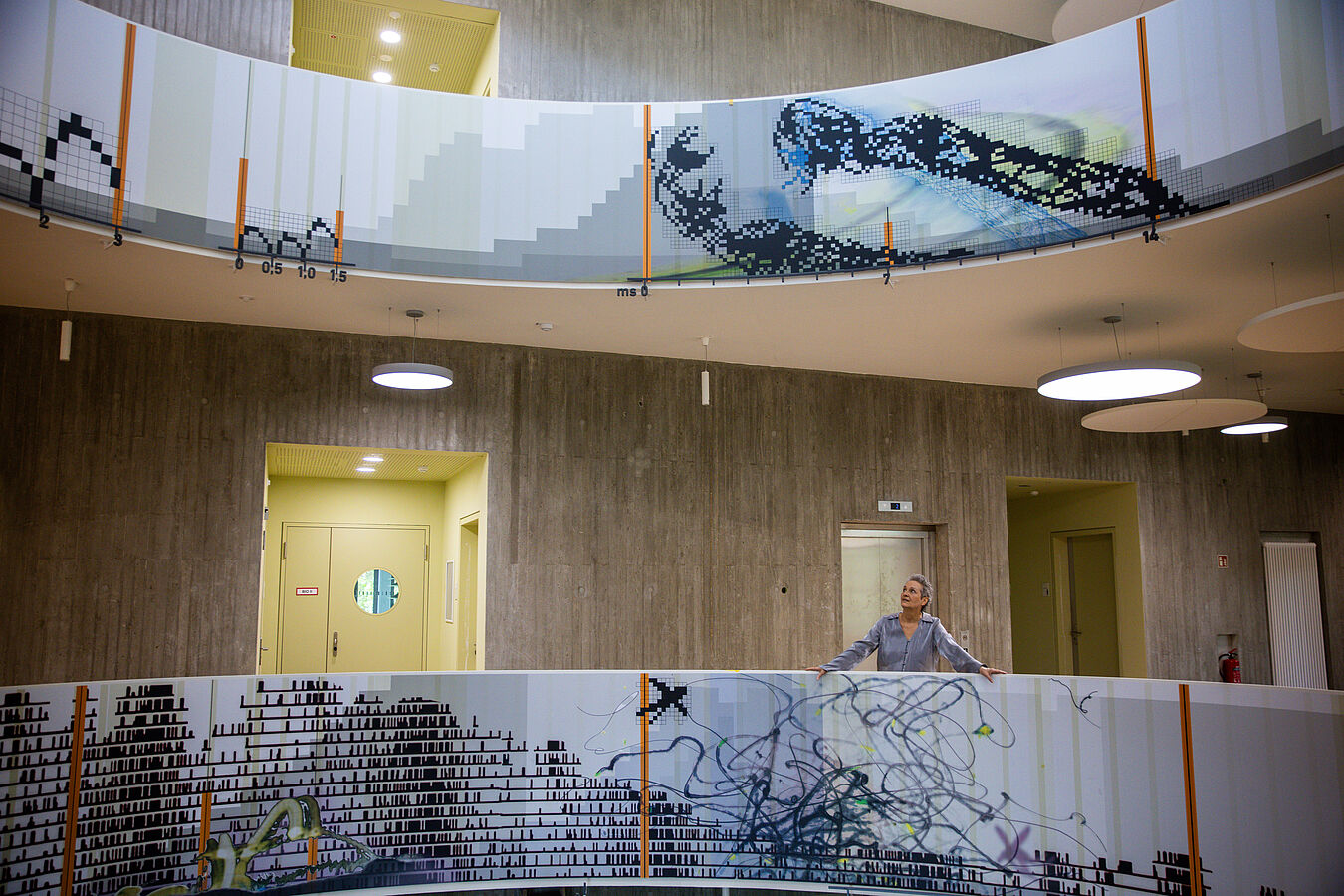
PL: “A Biological Clock” is an Art in Architecture project.[4] In other words, you won a public competition that you were invited to participate in. As an artist, what is it like for you to enter a competition with pretty strict rules?
UD: I often create art in public spaces and have participated in numerous competitions. This was the smallest competition I have entered so far. However, since it was an invitation-only competition with a limited number of artists, I was eager to participate. Moreover, biodiversity is a topic close to my heart. I had to think creatively when coming up with ideas because, as I said, my usual approach wasn’t feasible in terms of budget. Then I came up with this visualization of a predator–prey system, which also represents temporal processes. How do beings living in different cosmoses, who perhaps don’t know much about each other, encounter one another, and what happens then? The sun and the annual rhythm serve as a global clock. Then there are the “small rhythms” of insects. I am most fascinated by insect motion sequences. I couldn’t include all of that in my work. Daphnia exhibit a hop-and-sink rhythm, literally swinging as they move. This rhythm changes in the presence of their predators, Chaoborus larvae, i.e., phantom midge larvae. The relationship between these two organisms is a classic example of predator–prey interactions. Simulating this relationship is a common exercise in programming. On the first floor of the building, I captured the moment when the Chaoborus larva encounters and engulfs the Daphnia – a lightning-fast movement – graphically. The pixelated nature of the graphic highlights the necessary abstraction in science.
PL: The way you capture motion in graphics is very unique.
UD: For this particular image, we wrote a small computer program to record the traces of motion. So I didn’t draw it myself, but extracted the trace from the video.
PL: You talk about “we.” Who did you team up with?
UD: I always work with Felix Bonowski. He’s a molecular biologist and an excellent thinker. However, he turned his back on science because he believes that artistic methods offer more freedom. I discuss almost every project with him.
PL: How did you choose the two organisms that are the subject of your work, “A Biological Clock”?
UD: For the installation “The Greenhouse Converter,” I bred water fleas at home for two or three years, beginning in 2012. I will start breeding them again for the “A Biological Clock” video.
I also used to work with mosquitoes quite often. For a long time, I bred their larvae in terrariums. They were Chironomidae, i.e., non-biting chironomids. Graphics of swarms of these mosquitoes were also incorporated into the Art in Architecture project. As you can see, I cheated a little here. Of course, Chironomidae are not Chaoborus. However, Chaoborus larvae swarm in a very similar way.
So I was already familiar with the interaction between mosquitoes and Daphnia, I had the necessary images and was able to implement the work quickly.
PL: Your work is now almost complete. Are you happy with how it fits into the Biodiversity Building? And how do you feel about now entrusting your work to others – the building’s users – in a public space?
UD: In Art in Architecture, you always work for others. That’s something you need to be aware of. At certain points in the project, I wasn’t entirely sure if the scientists would have preferred a different, more abstract theme related to genetics or ecosystems. My approach was somewhat old-fashioned for scientists. At the same time, I knew that recalling the different environments was very fitting.
I was almost shocked when I saw how well the work blended into the architecture. I hope people will be able to appreciate it. So far, I’ve only seen it covered up, but I have peeked under the covers. I thought: It has something of a chapel about it.
Ursula Damm (born 1960) is a German sculptor and mixed-media artist. Since 2008, she has been a professor of Media Environments at the Bauhaus-Universität Weimar. She studied at the Kunstakademie Düsseldorf and the Academy of Media Arts Cologne and received the Spiridon Neven DuMont Prize in 1998. Damm is internationally renowned for her interactive installations and media artworks. Her work has been showcased in numerous solo and group exhibitions worldwide and is included in prominent collections. She has also created artistic positions in public spaces, including the interactive installation “Turnstile” at the Schadowstraße subway station in Düsseldorf.
Talk with the artist | Interview conducted by Patricia Löwe on December 9, 2025.
[1] The artist Joseph Beuys coined the term “social sculpture.” By this, he meant that his works were intended to have a formative effect on viewers and enter into a creative dialogue with them. Thus, he aimed to produce art that would transform society.
[2] The term “real-time installation” refers to an installation in which images or sound are created in the moment rather than produced and recorded in advance.
[3] Jakob Johann Baron von Uexküll (1864–1944) was a German philosopher, biologist, and zoologist. He coined the term “environment.”
[4] In Germany, when public construction projects are carried out, it is a legal requirement that 1% of the construction costs be spent on works of art created specifically for the building or that interact with it. This concept is known as “Art in Architecture.”